本文へ移動

リサーチと発表

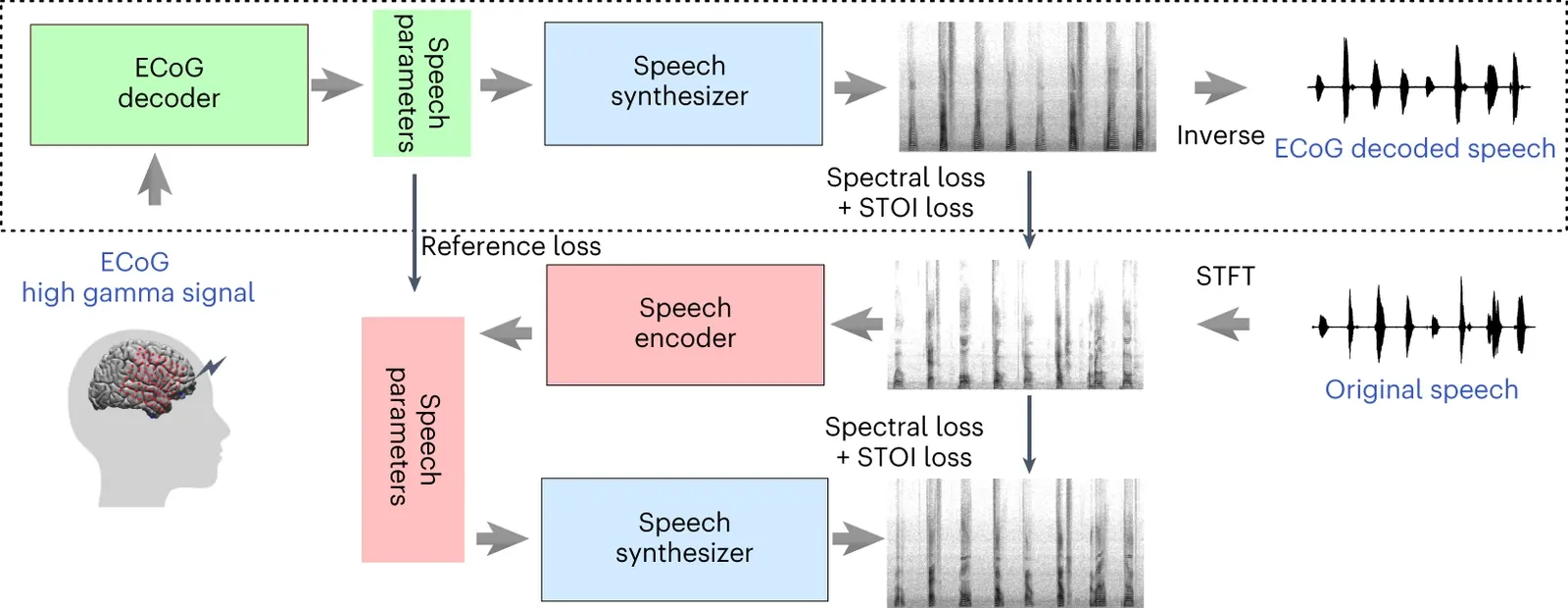
音声側のエラーは、デコーダーに戻るこのパスをたどりますトレーニングにより、神経信号と音声アノテーションをペアリングする必要がなくなります

水平にドラッグすると、プロセス全体が表示されます →

任意の停車地点をクリックして、このステップが何をしているかを確認します

01皮質シグナルECoG

電極アレイは、話している間に高いガンマ活性を記録するために、皮質の表面に適用される。各被験者は異なる電極位置を持っており、これはこのタイプの作業で最初に対処すべき問題である。

アイコンプレスA neural speech decoding framework leveraging deep learning and speech synthesis( Nature Machine Intelligence、2024 )。パラメータ名と値は、元のテキストから取得されます。

Chen Xupeng

Xupeng ChenCTO

Ph.D., Electrical Engineering, NYU

NYU Tandon School of Engineering · Advisors: Yao Wang, Adeen Flinker

Google Scholar

Top 5% of all research outputs scored by Altmetric

論文発表

リサーチマップ

ドットダイアグラム上の任意のポイントで対応するテキストにジャンプします

アトラス全体を表示するには水平方向にドラッグしてください →

2024神経信号と声

A neural speech decoding framework leveraging deep learning and speech synthesis

Nature Machine Intelligence · Vol. 6, No. 4, pp. 467–480

  • 5つのジャーナルとカンファレンス
  • 7つのプレプリント
  • 受賞歴がある、または注目度が高い

12記事・2020年~ 2026年・3行

  1. 2024Top 5% of all research outputs (Altmetric)

    A neural speech decoding framework leveraging deep learning and speech synthesis

    Xupeng Chen, Ran Wang, Amirhossein Khalilian-Gourtani, Leyao Yu, Patricia Dugan, Daniel Friedman, Werner Doyle, Orrin Devinsky, Yao Wang, Adeen Flinker

    Nature Machine IntelligenceVol. 6, No. 4, pp. 467–480doi:10.1038/s42256-024-00824-8

    An ECoG decoder that translates cortical signals into interpretable speech parameters, paired with a differentiable speech synthesizer. Reproducible across 48 participants; the 3D ResNet decoder reaches PCC 0.804 against the original spectrogram, and stays high under causal-only operation as required for real-time neural prostheses.

    ECoGデコーダは、元の音声スペクトルと比較して、マイクロスピーチシンセサイザーによってスペクトルに復元された音声パラメータを出力し、次にフレーム図をバックプロパゲートします

    水平にドラッグしてページ全体を表示 →

    Fig. 1フレーム全体の閉ループ: ECoGデコーダは、皮質の高ガンマ信号を解釈可能な音声パラメータのセットに変換し、マイクロスピーチシンセサイザによってスペクトルに還元することができます。シンセサイザーを微分することができるため、音声側の損失をデコーダに戻すことができます。トレーニングには、「神経信号—音声」アノテーションのペアを必要としません。オリジナル ↗·CC BY 4.0
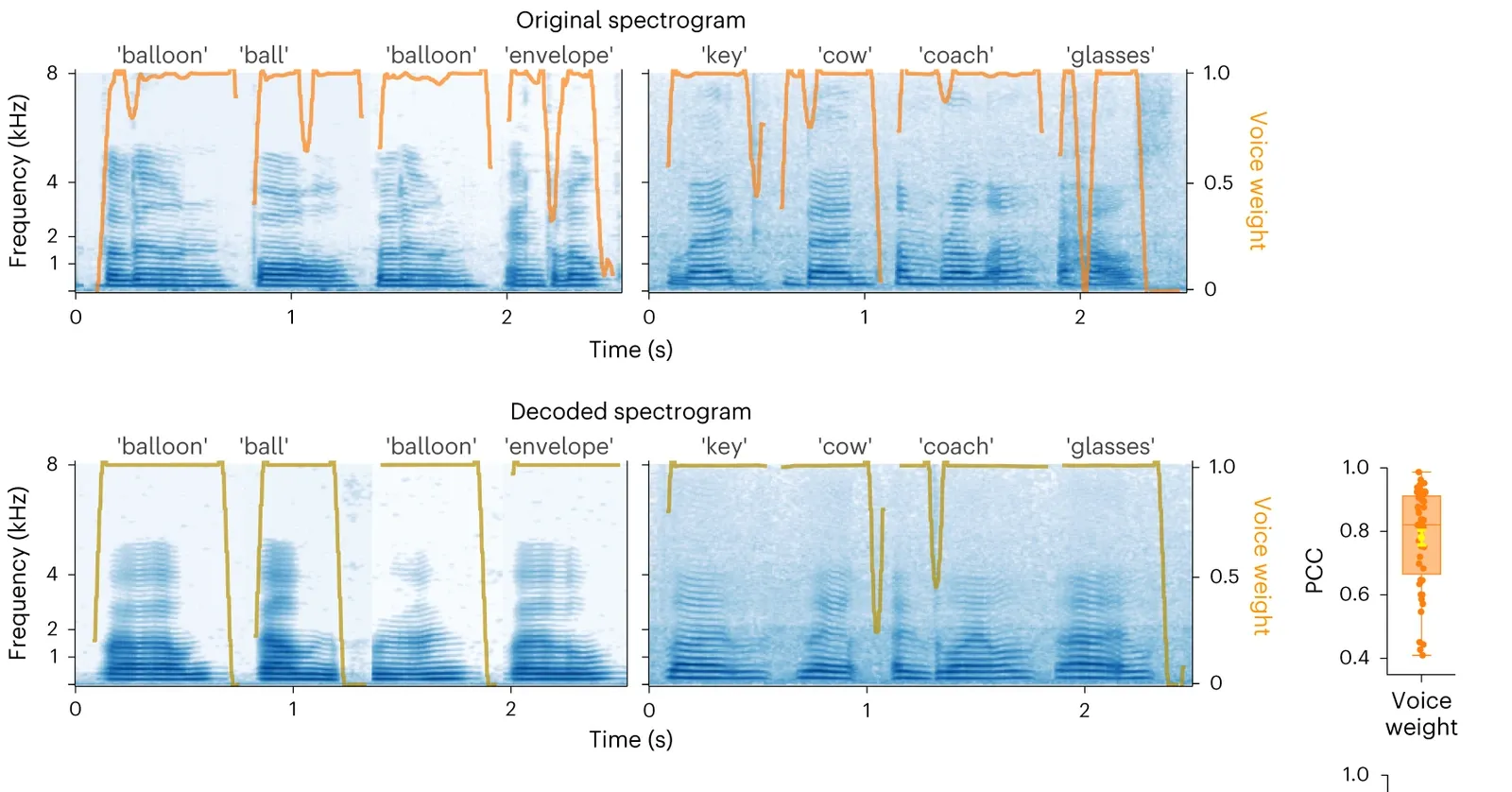
    元の音声スペクトルは、単語ごとに復号されたスペクトルと比較され、8つの英語の単語の調和構造は1つずつ対応します。

    水平にドラッグしてページ全体を表示 →

    Fig. 2c–d上昇は被験者が実際に話した8つの単語のスペクトルであり、下降は皮質信号によってのみデコードされたスペクトルです。高調波構造、開始および終了時間、ならびに濁度の変化はすべて正しく、3 D ResNetデコーダと元のスペクトルとの間の相関係数は、4 8人の被験者で0 . 8 0 4に達した。オリジナル ↗·CC BY 4.0
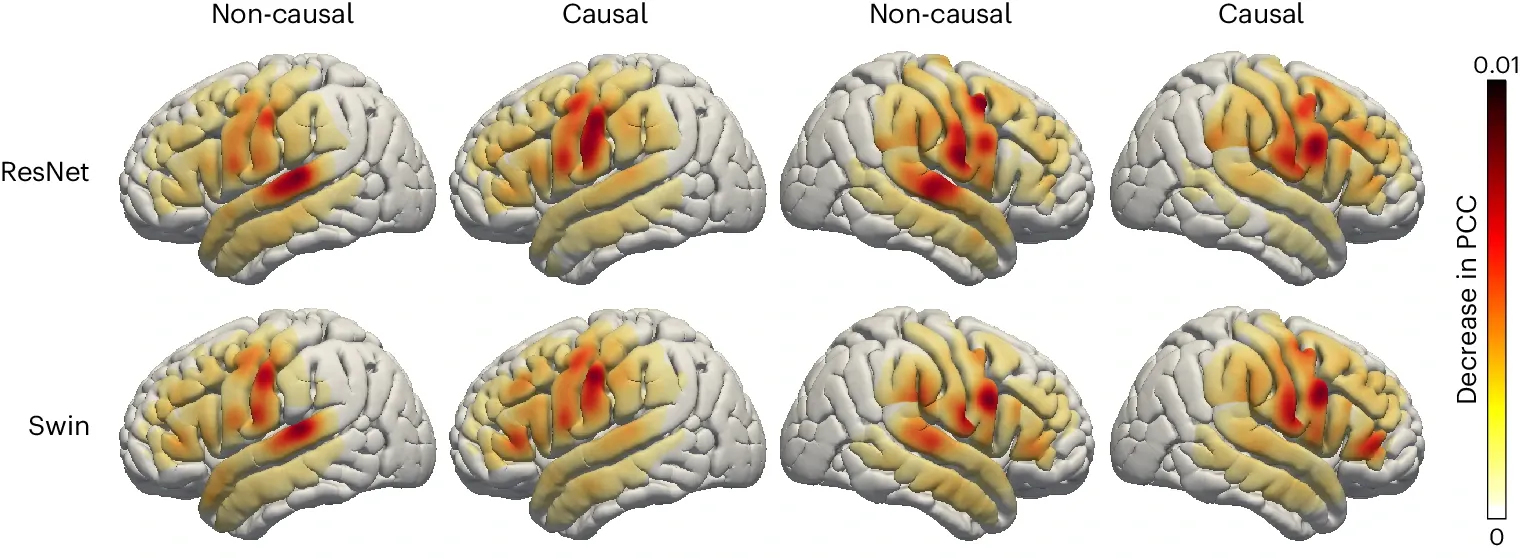
    各領域をマスキングした後の復号相関係数の低下を示す左大脳皮質のヒートマップで、ヒートゾーンは感覚運動皮質と上側頭回に集中している

    水平にドラッグしてページ全体を表示 →

    Fig. 4特定の皮質をカバーすると、デコードでどれだけの品質が失われますか?それが落ちるほど、色が濃くなります。ホットゾーンは、感覚運動皮質および上側頭回に集中しており、デコーダー、因果および非因果設定の両方で安定しています。この結論はモデルの選択に依存しておらず、モデルが生理学的に意味のある何かを学んだことを示している。オリジナル ↗·CC BY 4.0
  2. 2026

    Why Does Grounding Hurt Medical VQA? Benchmarking, Diagnosis, and Fine-Tuning of Vision-Language Models

    Xupeng Chen, Binbin Shi, Chenqian Le, Qifu Yin, Lang Lin, Haowei Ni, Ran Gong, Panfeng Li

    arXiv preprintarXiv:2604.27720

    Asks why telling a vision-language model where to look often makes its answer worse. Benchmarks frontier VLMs on medical grounding, separates the two failure modes — the box lands in the wrong place, or the box is right but cropping to it throws away the context the answer needed — and shows what fine-tuning does and does not fix.

  3. 2026

    Iterative Multimodal Retrieval-Augmented Generation for Medical Question Answering

    Xupeng Chen, Binbin Shi, Chenqian Le, Jiaqi Zhang, Kewen Wang, Ran Gong, Jinhan Zhang, Chihang Wang

    arXiv preprintarXiv:2604.27724

    MedVRAG retrieves over ~350K page images from the literature rather than over plain text, then decides for itself whether the evidence it pulled is enough — and goes back for more if it is not. Most questions settle in one round; the hard ones are exactly the ones that need a second and third.

  4. 2026

    Comparison of sEMG Encoding Accuracy Across Speech Modes Using Articulatory and Phoneme Features

    Chenqian Le, Ruisi Li, Beatrice Fumagalli, Yasamin Esmaeili, Xupeng Chen, Amirhossein Khalilian-Gourtani, Tianyu He, Adeen Flinker, Yao Wang

    arXiv preprintarXiv:2604.18920

    Surface EMG from the face and neck, compared across spoken, mimed and silently imagined speech. Asks how much of the articulatory signal survives when no sound is produced — the question any silent-speech interface has to answer before it can work.

  5. 2025

    VoxelFormer: Parameter-Efficient Multi-Subject Visual Decoding from fMRI

    Chenqian Le, Yilin Zhao, Nikasadat Emami, Kushagra Yadav, Xujin "Chris" Liu, Xupeng Chen, Yao Wang

    arXiv preprintarXiv:2509.09015

    Decodes what a person is looking at from fMRI, with one model shared across subjects instead of one model per brain. A token-merging encoder maps voxels into a CLIP embedding space, so adding a new subject costs a fraction of the parameters a per-subject model would.

  6. 2025

    Machine Learning-Based Prediction of Speech Arrest During Direct Cortical Stimulation Mapping

    Nikasadat Emami, Amirhossein Khalilian-Gourtani, Jianghao Qian, Antoine Ratouchniak, Xupeng Chen, Yao Wang, Adeen Flinker

    arXiv preprintarXiv:2509.08703

    Predicts which cortical sites will arrest speech when stimulated — the mapping a surgeon currently has to establish by stimulating the awake patient site by site. Same signal, read ahead of time instead of found the hard way.

  7. 2025

    When Thinking Fails: The Pitfalls of Reasoning for Instruction-Following in LLMs

    Xiaomin Li, Zhou Yu, Zhiwei Zhang, Xupeng Chen, Ziji Zhang, Yingying Zhuang, Narayanan Sadagopan, Anurag Beniwal

    arXiv preprintarXiv:2505.11423

    Chain-of-thought prompting is supposed to make models better. On instruction following it frequently makes them worse: the model reasons its way past a constraint it would have obeyed if asked directly. Measures where the trade-off bites and what mitigates it.

  8. 2025

    Transformer-based neural speech decoding from surface and depth electrode signals

    Junbo Chen, Xupeng Chen, Ran Wang, Chenqian Le, Amirhossein Khalilian-Gourtani, Erika Jensen, Patricia Dugan, Werner Doyle, Orrin Devinsky, Daniel Friedman, Adeen Flinker, Yao Wang

    Journal of Neural EngineeringVol. 22, No. 1, 016017doi:10.1088/1741-2552/adab21

    SwinTW, a transformer that works with arbitrarily positioned electrodes by using their 3D cortical coordinates rather than a 2D grid. Subject-specific models on low-density 8×8 ECoG reach PCC 0.817 across 43 participants, freeing future speech prostheses from grid-only electrode layouts.

  9. 2024

    R-LLaVA: Improving Med-VQA Understanding through Visual Region of Interest

    Xupeng Chen, Zhixin Lai, Kangrui Ruan, Shichu Chen, Jiaxiang Liu, Zuozhu Liu

    arXiv preprintarXiv:2410.20327

    Injects the region a clinician would actually look at straight into the visual token stream, so the model reasons over the lesion instead of over the whole slide. The line of work that the 2026 grounding benchmark above grew out of, and argued with.

  10. 2024

    A corollary discharge circuit in human speech

    Amirhossein Khalilian-Gourtani, Ran Wang, Xupeng Chen, Leyao Yu, Patricia Dugan, Daniel Friedman, Werner Doyle, Orrin Devinsky, Yao Wang, Adeen Flinker

    Proceedings of the National Academy of Sciences (PNAS)Vol. 121, No. 50, e2404121121doi:10.1073/pnas.2404121121

    Identifies a reproducible corollary discharge source in ventral speech motor cortex that fires before articulation and predicts how strongly auditory cortex is suppressed during speech — how the brain tells its own voice apart from the world.

  11. 2023

    Distributed feedforward and feedback cortical processing supports human speech production

    Ran Wang, Xupeng Chen, Amirhossein Khalilian-Gourtani, Leyao Yu, Patricia Dugan, Daniel Friedman, Werner Doyle, Orrin Devinsky, Yao Wang, Adeen Flinker

    Proceedings of the National Academy of Sciences (PNAS)Vol. 120, No. 42, e2300255120doi:10.1073/pnas.2300255120

    Uses causal, anticausal and noncausal convolutional architectures to disentangle motor control from sensory processing during speech, revealing a mixed feedforward/feedback recruitment across perisylvian cortex.

  12. 2020Best Paper Award Finalist

    Stimulus Speech Decoding From Human Cortex with Generative Adversarial Network Transfer Learning

    Ran Wang, Xupeng Chen, Amirhossein Khalilian-Gourtani, Zhaoxi Chen, Leyao Yu, Adeen Flinker, Yao Wang

    IEEE International Symposium on Biomedical Imaging (ISBI)

    Applies GAN transfer learning to decode heard speech from cortical recordings, addressing the scarcity of paired neural-speech data.

ページ上の3つの元の図面は、上記の論文から取られたものであり、これらはすべてオープンアクセスであり、CC BY 4.0の下でライセンスされており、署名およびライセンスされたリンクは図面に示されています。レイアウトはレイアウトの幅でスケーリングされ、個々のダイアグラムのサブパネルのみが撮影され、ピクセルの色は変更されていません。残りの論文は出版社の著作権で保護されており、複製することは許可されていません。

論文からプロダクトへ

学術研究と実装

01

口に出さない言葉を残す

リサーチ

博士課程では、CTOでチーフサイエンティストのXupeng Chenの研究は、デコーダが解釈可能な音声出力を出力し、それらを安定的に再現する神経信号から音声をデコードすることに焦点を当てています。また、その人自身が発声していないときに脳内で形成された思考を復元することにも焦点を当てます。これには、次元の入り口の技術的な遺伝子も組み込まれています。

製品への落下

これが、私たちのフレーズ「毎秒8ビット」の由来です。今日の製品は皮質に到達していませんが、方向は同じです: MinuteXは最初にスピーチの全体を保持し、それから曖昧なところにそれを押し込みます、と半分は言いました、そしてその時それを言う時間がありませんでした。

対応紙Nature Machine Intelligence 2024Journal of Neural Engineering 2025PNAS 2024arXiv:2604.18920arXiv:2509.08703

02

ビッグモデルをスマートに

リサーチ

過去2年間で、このラインはマルチモーダルになっています。モデルは正しく答えられていますが、それは正しい場所を見たという意味ではありません。「どこを見るべきか」と「何を答えるべきか」を別々に分けて評価したところ、医療画像ではフロンティアモデルが間違っていることが多かったが、答えは非常に似ており、エビデンスを指摘できるように、検索もプレーンテキストからページ画像検索に変更した。

製品への落下

どのような結論も、画像から読み取られている限り、同じ質問を迂回することはできません。どの部分を見たかを指すことができなければなりません。これは、製品のエビデンスによって追跡される一連のものの起源です。結論を追跡できません。インターフェースには表示されません。

対応紙arXiv:2604.27720arXiv:2604.27724arXiv:2410.20327arXiv:2509.09015

03

推論は理解と同じではありません

リサーチ

回答する前にモデルを考えてほしいのですが、これは命令のコンプライアンスを悪化させます。この記事では、モデルの過剰な推論時間が元の制約をどのように覆し、モデルの過剰な推論によって引き起こされる認知負荷をどのように軽減するかを明らかにします。

製品への落下

マルチエージェントシステムでは、エージェントが主導権を握り、リンクに沿ってエラーを渡します。したがって、修正を明示的なアクション(確認/修正/却下/アップサート)にします。これは、当社の製品プラクティスで最先端の研究を使用した結果です。

対応紙arXiv:2505.11423

独立した研究領域

都市知能と時空間コンピューティング

Guanjie Zheng

Guanjie Zhengテニュアトラック准教授

His research focuses on AI methods that understand, represent, and interact with complex urban and transportation systems.

John Hopcroft Center for Computer Science · Shanghai Jiao Tong University

Ph.D., Information Sciences and Technology, Penn State, 2020 · Advisor: Zhenhui (Jessie) Li

B.E., Electrical Engineering, Shanghai Jiao Tong University, 2015

受賞・評価

  • ECML-PKDD 2020 Best Applied Data Science Paper Award
  • Baidu AI Chinese Rising Stars Top 100
  • ACM SIGSPATIAL China Rising Star in Spatial Intelligence

研究領域

Spatial Reasoning on Multimodal Models in Urban Environments

Integrating maps, trajectories, imagery, and text to reason about urban dynamics and transportation systems.

Urban Foundation Representation Models

Learning scalable, transferable representations for prediction, simulation, and generalization across cities.

Reliable and Trustworthy Embodied Urban AI

Building reliable, safe, and transparent agents for complex real-world urban systems.

全発表一覧

45本 · 2017–2026 · # 責任著者 · * 共同貢献

20264本
  1. 01

    TRACK: Temporal Decoupled Kriging for Inductive Spatio-temporal Graph

    Jianping Zhou, Weida Wang, Bin Lu, Guanjie Zheng, Lei Bai, Xinbing Wang, Chenghu Zhou

    IEEE Transactions on Knowledge and Data Engineering

  2. 02

    OSM+: Billion-Level OpenStreetMap Data Processing System for City-wide Experiments

    Guanjie Zheng, Ziyang Su, Yiheng Wang, Yuhang Luo, Hongwei Zhang, Xuanhe Zhou, Linghe Kong, Fan Wu, Wen Ling

    International Conference on Machine Learning (ICML)

  3. 03

    GeoFlow: Geo-Aware Modeling of Inter-Area Relationships in OD Flow Prediction and Generation

    Zherui Huang, Guanjie Zheng, Hao Xue, Linghe Kong

    International Conference on Machine Learning (ICML)Spotlight

  4. 04

    Planning Under Observation Mismatch for Traffic Signal Control via Adaptive Modular World Models

    Zherui Huang, Yicheng Liu, Chumeng Liang, Guanjie Zheng

    International Conference on Automated Planning and Scheduling (ICAPS)

20255本
  1. 01

    MetaCity: Data-driven sustainable development of complex cities

    Yunke Zhang, Yuming Lin, Guanjie Zheng, Yu Liu, Nicholas Sukiennik, Fengli Xu, Yongjun Xu, Feng Lu, Qi Wang, Yuan Lai, Li Tian, Nan Li, Dongping Fang, Fei Wang, Tao Zhou, Yong Li, Yu Zheng, Zhiqiang Wu, Huadong Guo

    The Innovation

  2. 02

    Big-data empowered traffic signal control could reduce urban carbon emission

    Kan Wu, Jianrong Ding, Jingli Lin, Guanjie Zheng, Yi Sun, Jie Fang, Tu Xu, Yongdong Zhu, Baojing Gu

    Nature Communications

  3. 03

    Safety-critical traffic simulation with adversarial transfer of driving intentions

    Zherui Huang, Xing Gao, Guanjie Zheng#, Licheng Wen, Xuemeng Yang, Xiao Sun

    IEEE International Conference on Robotics and Automation (ICRA)

  4. 04

    MagiNet: Mask-Aware Graph Imputation Network for Incomplete Traffic Data

    Jianping Zhou, Bin Lu, Zhanyu Liu, Siyu Pan, Xuejun Feng, Hua Wei, Guanjie Zheng#, Xinbing Wang, Chenghu Zhou

    ACM Transactions on Knowledge Discovery from Data

  5. 05

    Multi-scale Traffic Pattern Bank for Cross-city Few-shot Traffic Forecasting

    Zhanyu Liu, Guanjie Zheng#, Yanwei Yu

    ACM Transactions on Knowledge Discovery from Data

20246本
  1. 01

    Graph Data Condensation via Self-Expressive Graph Structure Reconstruction

    Zhanyu Liu, Chaolv Zeng, Guanjie Zheng#

    ACM SIGKDD Conference on Knowledge Discovery and Data Mining (KDD)

  2. 02

    Dataset Condensation for Time Series Classification via Dual Domain Matching

    Zhanyu Liu, Ke Hao, Guanjie Zheng#, Yanwei Yu

    ACM SIGKDD Conference on Knowledge Discovery and Data Mining (KDD)

  3. 03

    Precise Control Balances Epidemic Mitigation and Economic Growth

    Yiheng Wang, Guanjie Zheng#, Hexi Jin, Yi Sun, Kan Wu, Jie Fang

    npj Urban Sustainability

  4. 04

    Frequency Enhanced Pre-training for Cross-city Few-shot Traffic Forecasting

    Zhanyu Liu, Jianrong Ding, Guanjie Zheng#

    European Conference on Machine Learning and Principles and Practice of Knowledge Discovery in Databases (ECML PKDD)

  5. 05

    Towards Controlled Table-to-Text Generation with Scientific Reasoning

    Zhixin Guo, Jianping Zhou, Jiexing Qi, Mingxuan Yan, Ziwei He, Guanjie Zheng#, Zhouhan Lin, Xinbing Wang, Chenghu Zhou

    IEEE International Conference on Acoustics, Speech and Signal Processing (ICASSP)

  6. 06

    GeoKnowledgeFusion: A Platform for Multimodal Data Compilation from Geoscience Literature

    Zhixin Guo, Chaoyang Wang, Jianping Zhou, Guanjie Zheng#, Xinbing Wang, Chenghu Zhou

    Remote Sensing

20235本
  1. 01

    CBLab: Supporting the Training of Large-scale Traffic Control Policies with Scalable Traffic Simulation

    Chumeng Liang, Zherui Huang, Yicheng Liu, Zhanyu Liu, Guanjie Zheng#, Hanyuan Shi, Kan Wu, Yuhao Du, Fuliang Li, Zhenhui Li

    ACM SIGKDD Conference on Knowledge Discovery and Data Mining (KDD)

  2. 02

    Cross-city Few-Shot Traffic Forecasting via Traffic Pattern Bank

    Zhanyu Liu, Guanjie Zheng#, Yanwei Yu

    ACM International Conference on Information and Knowledge Management (CIKM)

  3. 03

    FDTI: Fine-Grained Deep Traffic Inference with Roadnet-Enriched Graph

    Zhanyu Liu, Chumeng Liang, Guanjie Zheng#, Hua Wei

    European Conference on Machine Learning and Principles and Practice of Knowledge Discovery in Databases (ECML PKDD)

  4. 04

    Uncertainty-aware Traffic Prediction under Missing Data

    Hao Mei, Junxian Li, Zhiming Liang, Guanjie Zheng, Bin Shi, Hua Wei

    IEEE International Conference on Data Mining (ICDM)

  5. 05

    Multiplex Heterogeneous Graph Neural Network with Behavior Pattern Modeling

    Chaofan Fu, Guanjie Zheng, Chao Huang, Yanwei Yu, Junyu Dong

    ACM SIGKDD Conference on Knowledge Discovery and Data Mining (KDD)

20223本
  1. 01

    CTRL: Cooperative Traffic Tolling via Reinforcement Learning

    Yiheng Wang, Hexi Jin, Guanjie Zheng#

    ACM International Conference on Information and Knowledge Management (CIKM)

  2. 02

    MedAttacker: Exploring Black-Box Adversarial Attacks on Risk Prediction Models in Healthcare

    Muchao Ye, Junyu Luo, Guanjie Zheng, Cao Xiao, Houping Xiao, Ting Wang, Fenglong Ma

    IEEE International Conference on Bioinformatics and Biomedicine (BIBM)

  3. 03

    CTRL: Using a Neural Network-Physics-Based Hybrid Model to Predict Soil Reaction Fronts

    Tao Wen, Chacha Chen, Guanjie Zheng, Joel Bandstra, Susan L. Brantley

    Computers & Geosciences

20216本
  1. 01

    Knowledge-based Residual Learning

    Guanjie Zheng, Chang Liu, Hua Wei, Porter Jenkins, Chacha Chen, Tao Wen, Zhenhui Li

    International Joint Conference on Artificial Intelligence (IJCAI)

  2. 02

    Objective-aware Traffic Simulation via Inverse Reinforcement Learning

    Guanjie Zheng, Hanyang Liu, Kai Xu, Zhenhui Li

    International Joint Conference on Artificial Intelligence (IJCAI)

  3. 03

    Learning to Simulate on Sparse Trajectory Data

    Hua Wei, Chacha Chen, Chang Liu, Guanjie Zheng, Zhenhui Li

    Machine Learning and Knowledge Discovery in Databases: Applied Data Science Track (ECML PKDD)

  4. 04

    Rebuilding City-Wide Traffic Origin-Destination from Road Speed Data

    Guanjie Zheng*, Chang Liu*, Hua Wei, Chacha Chen, Zhenhui Li

    IEEE International Conference on Data Engineering (ICDE)

  5. 05

    Recent Advances in Reinforcement Learning for Traffic Signal Control: A Survey of Models and Evaluation

    Hua Wei, Guanjie Zheng, Vikash Gayah, Zhenhui Li

    ACM SIGKDD Explorations Newsletter

  6. 06

    Detecting Anomalous Methane in Groundwater within Hydrocarbon Production Areas across the United States

    Tao Wen, Mengqi Liu, Josh Woda, Guanjie Zheng, Susan L. Brantley

    Water Research

20205本
  1. 01

    GeneraLight: Improving Environment Generalization of Traffic Signal Control via Meta Reinforcement Learning

    Huichu Zhang, Chang Liu, Weinan Zhang, Guanjie Zheng, Yong Yu

    ACM International Conference on Information and Knowledge Management (CIKM)

  2. 02

    Learning to Simulate on Sparse Trajectory Data

    Hua Wei, Chacha Chen, Chang Liu, Guanjie Zheng, Zhenhui Li

    European Conference on Machine Learning and Principles and Practice of Knowledge Discovery in Databases (ECML PKDD)Best Applied Data Science Paper

  3. 03

    Toward A Thousand Lights: Decentralized Deep Reinforcement Learning for Large-Scale Traffic Signal Control

    Chacha Chen, Hua Wei, Nan Xu, Guanjie Zheng, Ming Yang, Yuanhao Xiong, Kai Xu, Zhenhui Li

    AAAI Conference on Artificial Intelligence (AAAI)

  4. 04

    MetaLight: Value-based Meta-Reinforcement Learning for Traffic Signal Control

    Xinshi Zang, Huaxiu Yao, Guanjie Zheng, Nan Xu, Kai Xu, Zhenhui Li

    AAAI Conference on Artificial Intelligence (AAAI)

  5. 05

    Learning to Simulate Vehicle Trajectories from Demonstrations

    Guanjie Zheng*, Hanyang Liu*, Kai Xu, Zhenhui Li

    IEEE International Conference on Data Engineering (ICDE), short paper

20196本
  1. 01

    Learning Phase Competition for Traffic Signal Control

    Guanjie Zheng, Yuanhao Xiong, Xinshi Zang, Jie Feng, Hua Wei, Huichu Zhang, Yong Li, Kai Xu, Zhenhui Li

    ACM International Conference on Information and Knowledge Management (CIKM)

  2. 02

    CoLight: Learning Network-level Cooperation for Traffic Signal Control

    Hua Wei, Nan Xu, Huichu Zhang, Guanjie Zheng, Xinshi Zang, Chacha Chen, Weinan Zhang, Yanmin Zhu, Kai Xu, Zhenhui Li

    ACM International Conference on Information and Knowledge Management (CIKM)

  3. 03

    Learning Traffic Signal Control from Demonstrations

    Yuanhao Xiong, Guanjie Zheng, Kai Xu, Zhenhui Li

    ACM International Conference on Information and Knowledge Management (CIKM)

  4. 04

    PressLight: Learning Max Pressure Control to Coordinate Traffic Signals in Arterial Networks

    Hua Wei, Chacha Chen, Guanjie Zheng, Kan Wu, Vikash V. Gayah, Kai Xu, Zhenhui Li

    ACM SIGKDD Conference on Knowledge Discovery and Data Mining (KDD)

  5. 05

    Targeted Transfer Reinforcement Learning for Traffic Signal Control in a Hierarchical Framework

    Nan Xu, Guanjie Zheng, Kai Xu, Yanmin Zhu, Zhenhui Li

    Pacific-Asia Conference on Knowledge Discovery and Data Mining (PAKDD)

  6. 06

    Revisiting Spatial-Temporal Similarity: A Deep Learning Framework for Traffic Prediction

    Huaxiu Yao*, Xianfeng Tang*, Hua Wei, Guanjie Zheng, Zhenhui Li

    AAAI Conference on Artificial Intelligence (AAAI)

20182本
  1. 01

    IntelliLight: A Reinforcement Learning Approach for Intelligent Traffic Light Control

    Hua Wei*, Guanjie Zheng*, Huaxiu Yao, Zhenhui Li

    ACM SIGKDD Conference on Knowledge Discovery and Data Mining (KDD)

  2. 02

    DRN: A Deep Reinforcement Learning Framework for News Recommendation

    Guanjie Zheng, Fuzheng Zhang, Zihan Zheng, Yang Xiang, Nicholas Jing Yuan, Xing Xie, Zhenhui Li

    The Web Conference (WWW)

20173本
  1. 01

    Contextual Spatial Outlier Detection with Metric Learning

    Guanjie Zheng, Susan L. Brantley, Thomas Lauvaux, Zhenhui Li

    ACM SIGKDD Conference on Knowledge Discovery and Data Mining (KDD)

  2. 02

    Assessing Environmental Impacts of Shale-gas Development in an Area of Hydraulic Fracturing

    Guanjie Zheng, Fei Wu, Matthew Gonzales, Susan L. Brantley, Thomas Lauvaux, Zhenhui Li

    KDD Workshop on Data Science for Intelligent Food, Energy, and Water (DSIFER)

  3. 03

    Discovery of Causal Time Intervals

    Zhenhui Li, Guanjie Zheng, Amal Agarwal, Lingzhou Xue, Thomas Lauvaux

    SIAM International Conference on Data Mining (SDM)

完全な一覧と著者記号は 上海交通大学の公式プロフィールに準拠しています。